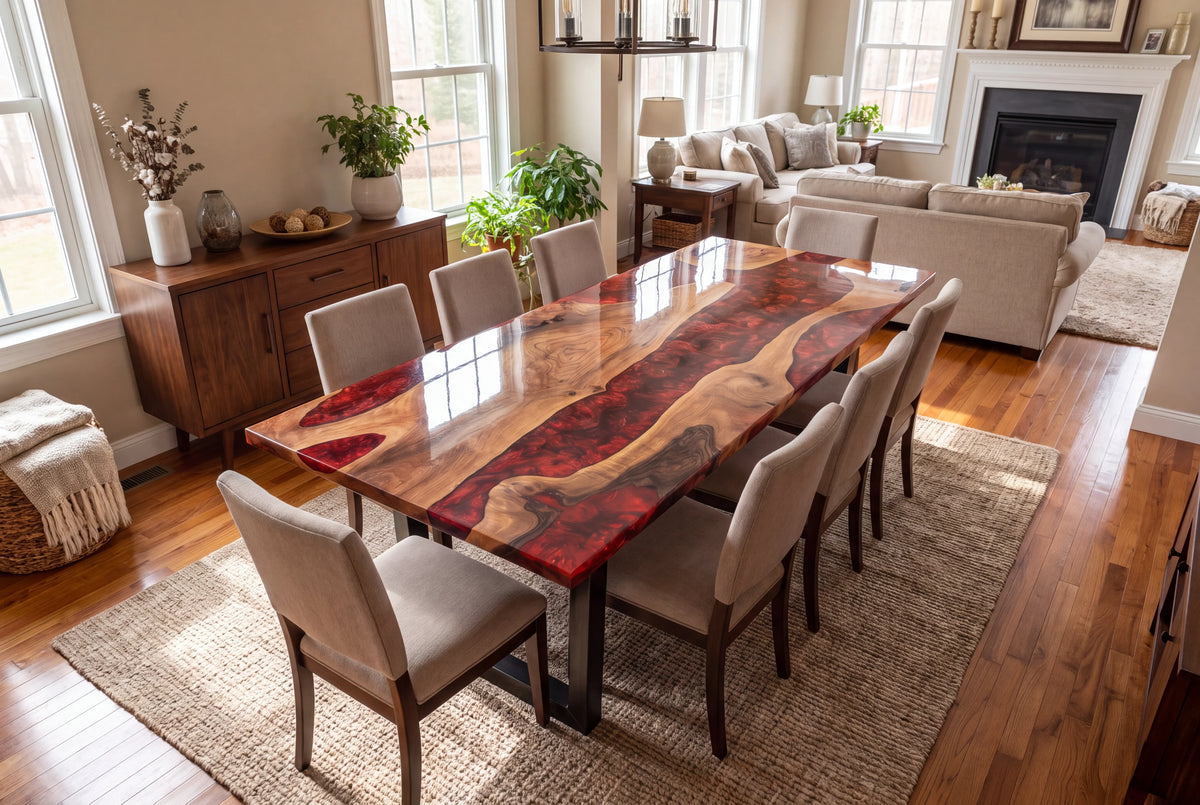
Epoxy resin tables are durable for everyday dining, but they are not indestructible: the resin is scratch-resistant rather than scratch-proof, it can soften under hot pans, and it can yellow in strong sunlight. If you can live with coasters, trivets and a spot out of direct sun, the main pros are a top made in exactly your size and colors, a smooth surface that wipes clean, and a slab that no other table shares.
This guide sets out both sides plainly, using what resin manufacturers themselves publish about their products. It is written for anyone weighing an epoxy dining table against solid wood, stone or glass, and it ends with the questions worth asking any maker before you order.
What is an epoxy resin table, exactly?
Most epoxy tables combine a solid wood slab, or several wood pieces, with poured epoxy resin. The resin may run through the middle as a river, fill natural cracks and voids, surround wood islands, or form a geometric pattern. The top is then sanded and finished, and set on a steel or wooden base.
So when people ask whether epoxy tables are durable, they are really asking about two materials at once: the resin and the wood, which is a natural material that reacts to the air around it. Both have strengths and limits, and the sections below cover each.
Are epoxy tables durable?
For a dining table in a normal home, yes. Cured epoxy is hard, closed and smooth, and it holds up to daily meals, homework and wiping. The weak points are specific and predictable: sharp or rough objects, heat, strong sunlight and strong dyes. Each is easy to manage once you know about it, and each is covered below with what the resin makers say.
It also helps to know that resins differ. A table top resin, a deep pour casting resin and a heat-resistant formula do not have the same limits. One manufacturer, UltraClear, notes in its scratch resistance guide that deep pour epoxy is not meant to be a stand-alone finish for wear surfaces such as table tops. That is a good reason to ask any maker what is on the top surface of the table you are buying.
Do epoxy tables scratch?
They can. ArtResin states in its FAQ that its cured resin is scratch-resistant, not scratch-proof, and that high-traffic surfaces can show wear over time. UltraClear describes its table top epoxy as very resilient but says it can still be scratched by sharp or rough edges, and it adds that scratch resistance only peaks once the resin is fully cured.
In practice, fine marks build up where plates, keys and laptops are slid around most. A few habits keep them to a minimum:
- Never cut food directly on the table. UltraClear specifically says to use a cutting board.
- Lift heavy or rough items instead of dragging them.
- Use placemats under plates and felt pads under decor.
- Clean with a soft, lint-free cloth. ArtResin warns that paper towels, microfiber cloths and scouring pads can cause fine scratches or dull the surface.
Finish is also a choice. Several of our tables, such as the Pearl Lagoon olive wood table, have a matte finish, while others are glossy.

How much heat can an epoxy table take?
Less than most people expect. This is the biggest limit of the material. ArtResin says its cured resin handles heat up to 120°F (50°C), and that a very hot mug can temporarily soften the surface and leave a faint impression. Marks pressed into warm, softened resin may stay after it hardens again. UltraClear gives a maximum of 135°F for its table top epoxy at full cure. Formulas made for higher heat exist; ArtResin's Industrial Clear is rated to 190°F (88°C).
Whatever resin is in your table, the safe rule is the same: a hot coffee cup on a coaster is fine, but pans, baking dishes and kettles go on a trivet, never straight onto the top.
Does epoxy resin turn yellow?
It can, mostly from ultraviolet light. ArtResin explains that it adds UV stabilizers to slow down degradation, including yellowing caused by UV exposure, yet it still does not recommend deliberately exposing the resin to UV light. Stabilizers slow the process; they do not stop it.
If your table will sit next to a large, sunny window, blinds or sheer curtains help. Think about where the table will stand when you choose the resin color too: you see your design in an AI preview before anything is made. The Eclipse walnut table, with its three-tone black and white resin, shows how far the color choice can go.

Epoxy resin table pros and cons at a glance
This table sums up the trade-offs covered in this guide. It is a planning aid, not a lab rating.
| Topic | Pro | Con | What to do |
|---|---|---|---|
| Everyday use | Hard, smooth surface that handles daily meals | Not indestructible | Treat it like a good wood or glass table |
| Scratches | Scratch-resistant once fully cured | Not scratch-proof; sharp or rough edges mark it | Placemats, cutting boards, no dragging |
| Heat | Fine with a hot cup on a coaster | Can soften under hot pans and dishes | Trivets for anything from the stove or oven |
| Sunlight | UV stabilizers slow yellowing | Can still yellow over time | Blinds on bright windows; no long direct sun |
| Spills | Closed surface wipes clean | Strong dyes can stain | Wipe spills quickly |
| Cleaning | A gentle glass cleaner is enough | Rough cloths and pads can dull it | Soft, lint-free cloth |
| Design | Any size, wood, resin color and base | Each slab differs from the photos | Approve the slab photo before production |
| Ordering | Made to your exact plan | You wait 4 to 11 weeks | Order well before you need it |
Do epoxy tables stain?
The closed resin surface wipes clean with a gentle cleaner and a soft cloth. The thing to watch is strong dye. UltraClear warns that red and other colored dyes can stain its epoxy, so red wine, colored drinks and food coloring should be wiped up quickly rather than left overnight. The exposed wood parts of the top are a separate surface, so ask the maker how the wood is finished and how to look after it.
Does the wood move in an epoxy table?
Wood keeps reacting to its surroundings long after it is cut. The USDA Forest Products Laboratory's Wood Handbook explains that moisture exchange between wood and air depends on the relative humidity and temperature of the air, and that many of the challenges of using wood come from changes in its moisture content. For a table owner, that means steady conditions are kinder to the top than extremes. Keep it away from radiators, heating vents and air conditioning outlets blowing straight at it.
The wood is also what gives each table its character. Walnut, olive and poplar each bring a different grain, as our wood and resin guide shows. The Archipelago poplar table, with its ocean blue resin, live edge islands and wooden bridges, is a good example of how much the wood shapes the design.

Can a scratched or damaged epoxy table be repaired?
Usually, yes, though not as a quick touch-up. ArtResin does not recommend spot fixing. Its advice is to sand the whole surface, clean off the dust and pour a fresh top coat, and it notes that sanding scuffs do not show through once the new coat is on. That is a job for a professional on a large dining table, so prevention is the better plan. Light daily marks are normal and rarely worth refinishing.
What are the other downsides of an epoxy dining table?
- Cost. A made-to-order slab and resin table is not the cheapest kind of dining table. Our custom epoxy resin table cost guide explains what drives the price.
- Waiting time. A made-to-order table is not in a warehouse. At Onyx Resin, production takes 3 to 8 weeks after design approval and shipping 1 to 3 weeks, so 4 to 11 weeks in total.
- Delivery and assembly. Large tops travel in a custom wooden crate with the top and base packed separately, and assembly is required. Delivery is included and insured, but customs duties are not included and are paid by the recipient.
- No two tops match. This is a pro for most buyers, but if you want a table identical to a photo, a natural slab will always differ. That is why we send a photo of the actual slab for your approval.
What are the real advantages of an epoxy table?
- Made in your size. You give the exact length and width that suit your room, rather than choosing from a few stock sizes. Not sure what size your room takes? Our free dining table size calculator works it out.
- Any resin color. Clear, black, white, deep blue, red, or a color matched to your room.
- Your choice of wood and base. Walnut, olive or poplar, on one of our steel leg designs or a fully custom base.
- Easy everyday cleaning. Resin makers advise treating cured resin like glass: a gentle glass cleaner and a soft cloth.
- A one-off piece. The Graphite River walnut live edge table, for example, follows the natural edges of its walnut slab with a transparent gray resin river. The next slab will never look quite the same.

You can see the full range of woods, resin colors and shapes in our epoxy dining table collection. Every design there is made to order, so any of them can be adjusted to your size, wood, resin color and base.
Questions to ask before you buy an epoxy table
- What resin is on the top surface, and what heat and care guidance comes with it?
- Will I see a photo of the actual slab before production starts?
- Can I choose a matte or gloss look, and which suits a busy family table?
- How is the exposed wood finished, and how should I look after it?
- How is the table packed and delivered, and who pays any import duties?
- How long from design approval to delivery?
Frequently asked questions
Are epoxy tables durable enough for a family dining table?
Yes, for normal family use. Cured epoxy is hard and easy to wipe clean. Use placemats, cutting boards and trivets, and keep the table out of strong direct sun.
Do epoxy tables scratch easily?
Not easily, but they can scratch. Manufacturers describe cured resin as scratch-resistant, not scratch-proof. Sharp or rough edges and dragged objects cause most marks.
Can I put a hot plate on an epoxy table?
A warm plate or a hot cup on a coaster is fine. Hot pans and dishes straight from the oven should go on a trivet, because the two table resin makers cited above rate their products at 120°F and 135°F.
Will my epoxy table turn yellow?
Epoxy can yellow over time with UV exposure, even with UV stabilizers. Keeping the table out of long periods of direct sun slows it down.
How do I clean an epoxy resin table?
Treat it like glass: a gentle glass cleaner and a soft, lint-free cloth. Avoid scouring pads and rough cloths, and wipe up colored spills quickly.
Is an epoxy table better than a solid wood table?
It depends on what you want. Epoxy gives you color and design choices that solid wood cannot, while asking for a little more care with heat and sunlight.
Get a free quote for your epoxy table
If the pros outweigh the cons for you, tell us your exact table size, your preferred wood and resin color, and the style you like. Within 48 hours you get a free quote and an AI preview of your table, or real photos of similar past work. Request your free quote, or browse more epoxy resin dining tables for ideas first.

Leave a comment
All comments are moderated before being published.
This site is protected by hCaptcha and the hCaptcha Privacy Policy and Terms of Service apply.