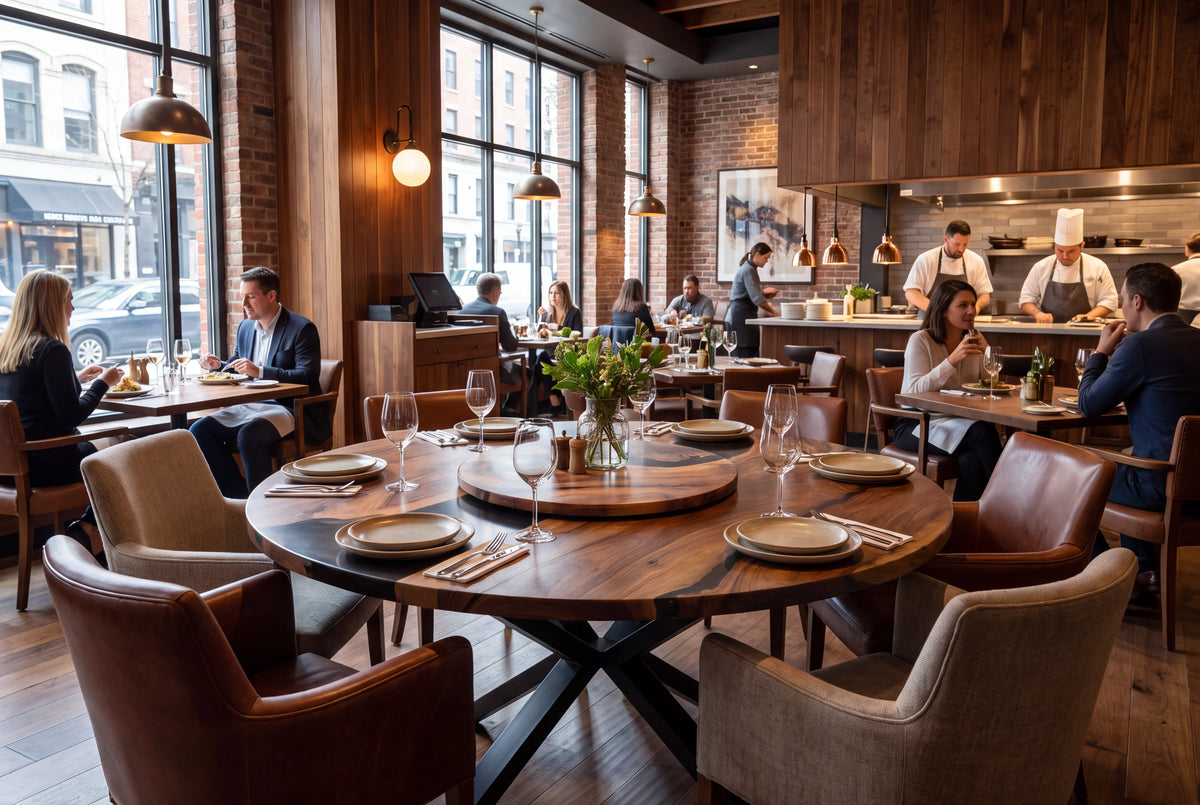
Resin restaurant tables can work well in a restaurant, bar or café if you plan for heat, wear and cleaning from the start: the resin surface is scratch-resistant but not scratch-proof, and many resins soften well below the temperature of a plate fresh from the kitchen. Order a custom top made in your sizes, decide early where hot dishes will sit, and plan the accessible seats and the delivery schedule before production starts.
This guide is for restaurant owners, operators and the designers who fit out their rooms. It covers what epoxy resin handles well, where it needs care, how to plan sizes and accessible seating, and what to settle with the maker before you order a set of custom restaurant tables.
What is a resin restaurant table?
The term covers two quite different products. Many "resin" table tops sold for restaurants are molded or laminated tops in a fixed size and a wood-look finish. A wood and epoxy resin table is something else: a solid wood slab or set of wood pieces combined with poured epoxy resin, often as a river, island pattern or filled cracks, then sanded and finished.
That second type is what we make at Onyx Resin. Each table is made to order in the client's size, wood, resin color and base, with walnut, olive and poplar as the woods we offer and any resin color you like. We make restaurant, bar and café tables and table tops, including multi-table orders, and price every one per project through a quote. If you are planning a whole room or a one-off feature piece, our bespoke resin furniture page shows how a custom project runs.
Are epoxy resin tables durable enough for a restaurant?
They can be, as long as you understand the limits of the surface. Commercial tables take far more abuse than a home dining table: plates slid across the top, cutlery dropped, hot dishes, spills and constant wiping. Three properties matter most.
Scratches
Cured epoxy is hard, but it is not glass. Resin manufacturer ArtResin puts it plainly in its FAQ: its resin is scratch-resistant, not scratch-proof, and high-traffic surfaces like countertops can show wear over time. In a restaurant, expect fine marks to build up where plates and glasses are moved most.
Heat
Heat is the biggest limit. ArtResin states that its cured resin handles heat up to 120°F (50°C), and that its sister product made for higher heat goes up to 190°F (88°C). It warns that very hot items placed directly on cured resin can soften it and leave impressions while it is warm. Resin products differ, so treat these numbers as an example rather than a rule for every table. For restaurant use, the practical answer is the same either way: serve hot dishes on plates, boards or trivets, never straight from the oven onto the top.
Sunlight and yellowing
Epoxy resin can yellow over time under UV light. ArtResin explains that it adds light stabilizers to slow yellowing caused by UV exposure, but that deliberately exposing the resin to UV light is still not recommended. Tables next to a sunny shopfront window or on an open terrace are the ones to think about.
Resin, wood and resin, or plain wood: how do they compare?
This table summarizes the trade-offs covered above. It is a planning aid, not a lab rating.
| Question | Wood and epoxy resin top | What to plan for |
|---|---|---|
| Hot plates and pans | Resin can soften under direct high heat | Plates, boards or trivets between hot items and the top |
| Daily scratches | Scratch-resistant, not scratch-proof | Coasters and plates in high-use spots; no sliding of heavy items |
| Strong sunlight | Resin can yellow under UV light | Blinds on bright windows; avoid open terraces |
| Cleaning | Smooth, closed surface | A gentle cleaner and a soft cloth; ask the maker before using harsh chemicals |
| Look | Each slab is different | Approve the slab photo before production |
What designs suit restaurants, bars and cafés?
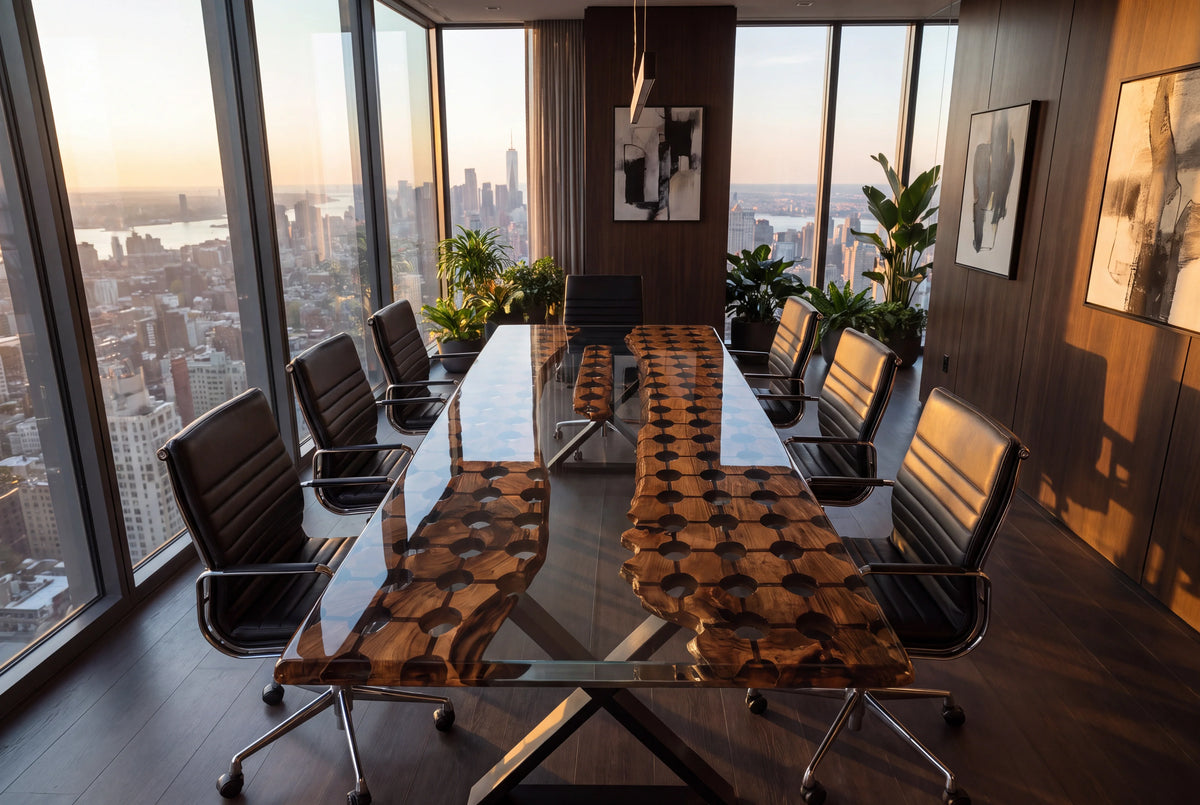
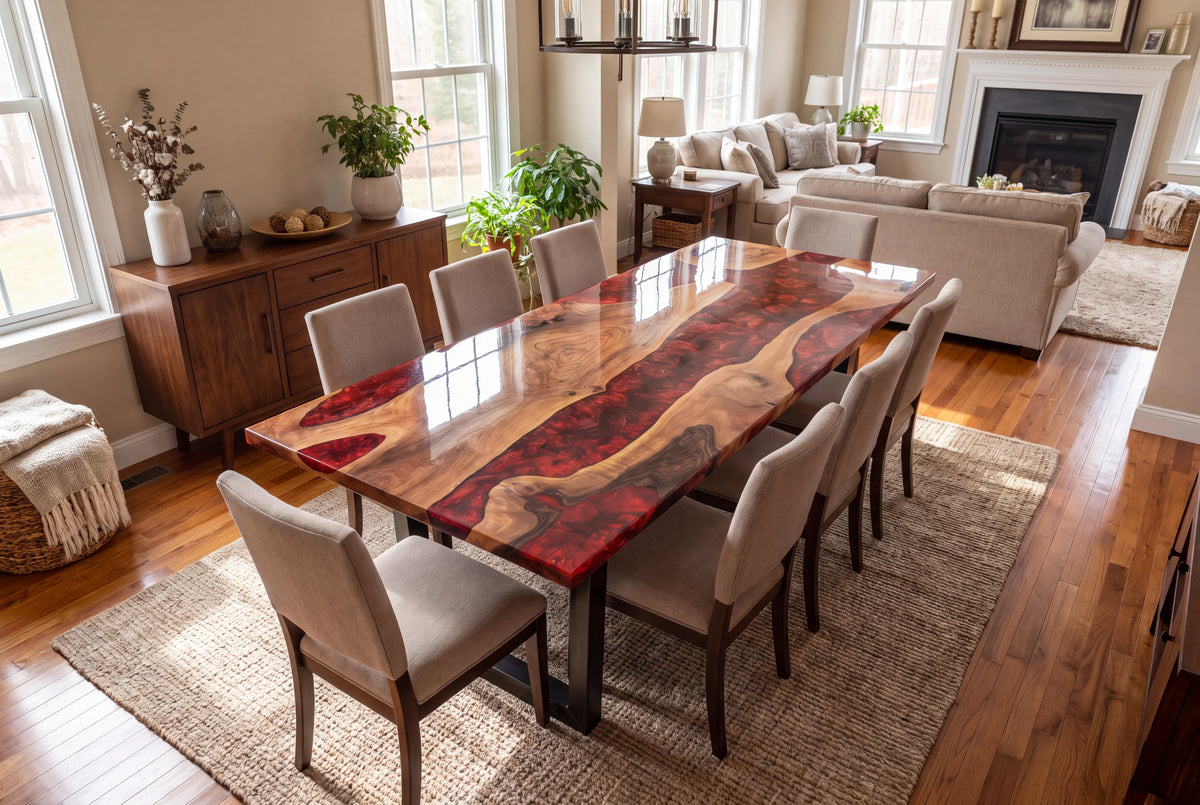
We have no photos of restaurant installs yet, so the pieces below are from our home and office range. They show the materials, shapes and bases we can adapt for a commercial room.
Round café and two-top tables. A round top on a single pedestal base is a common layout for small tables. The Sunburst walnut round table, with clear resin petals on a pedestal base, shows that layout.

Shared plates. For family-style service, the Smoke Ring round table has a built-in lazy susan in the center, made in walnut with black resin.
Bar ledges and window counters. A narrow top fixed against a wall or window works as a standing ledge. The Apex walnut bar console, a narrow piece with a clear resin honeycomb, shows the proportion.

Communal and feature tables. A long live edge table makes a natural centerpiece for a group table or a chef's table. The Salt River walnut table pairs a live edge with solid white resin and a matte finish.

These are only a few examples. Every design in our dining table collection can also be made as a restaurant, bar or café table, in the size you need, with the same wood, resin color and base options.
How do you plan sizes and accessible seating?
Start with your floor plan and covers, then size the tops. Because every table is made to order, you can mix two-tops, four-tops and a long communal table in one order instead of fitting the room around stock sizes.
To try a layout before you order, use our free restaurant table layout planner. Enter the size of your dining area and it lays out two-tops and four-tops on a scale plan, counts the seats and shows how many accessible seats to plan for.
In the US, accessibility rules affect the tables themselves. Under the ADA, at least 5 percent of the seating spaces at dining surfaces must be accessible, and those seats should be spread across the room rather than grouped in one corner. A city plan-review checklist from Long Beach, California summarizes the key numbers, and the 2010 ADA Standards set the height of dining surfaces.
| Requirement for an accessible seat | Figure |
|---|---|
| Share of seating at dining surfaces | At least 5 percent |
| Height of the table top | 28 to 34 inches (711 to 864 mm) above the floor |
| Knee clearance width | At least 30 inches (760 mm) |
| Knee clearance height | At least 27 inches (685 mm) above the floor |
| Knee clearance depth | At least 19 inches (485 mm) |
This is where the base matters. On a custom table you choose one of our steel leg designs or a fully custom base, so tell us which tables need accessible seats and we keep the legs and pedestal clear of that position. Your architect or local building official has the final word on what applies to your project.
What should you settle with the maker before ordering?
- Quantities and sizes. A list of every table, its shape, top size and height (dining, counter or bar).
- Wood and resin color. Walnut, olive or poplar, and any resin color. Think about sunlight near windows.
- Bases. Steel legs or a custom base, with accessible seats marked.
- Logo or branding. A logo can be set into a table, and the logo detail is worked out in the preview before production.
- Timeline. Production takes 3 to 8 weeks after design approval and shipping 1 to 3 weeks, so allow 4 to 11 weeks in total before your opening date.
- Delivery and assembly. Worldwide delivery is included and insured, in a custom wooden crate with the top and base packed separately. Assembly is required, so plan who installs the tables. Customs duties are not included and are paid by the recipient.
Our How It Works page walks through each step, from the quote and preview to the slab photo you approve and the photo updates during production. Interior designers specifying tables for a client can also see our trade program.
How do you care for resin tables in a busy restaurant?
- Wipe, don't scrub. ArtResin advises treating cured resin like glass: a gentle glass cleaner and a soft, lint-free cloth. It also warns that paper towels and microfiber cloths can cause fine scratches.
- Keep heat off the top. Use plates, boards and trivets for anything hot.
- Watch the sun. Use blinds on bright windows.
- Brief the staff. Add the care points above to the closing checklist: soft cloths only, no hot pans on the top, and lift heavy items instead of sliding them.
Frequently asked questions
Are resin tables good for restaurants?
Yes, if you plan for their limits. Epoxy resin is scratch-resistant but not scratch-proof and can soften under direct high heat, so use plates or trivets for hot dishes and a gentle cleaner with a soft cloth.
Can you make custom restaurant tables in different sizes in one order?
Yes. We make restaurant, bar and café tables and table tops, including multi-table orders, each made to order in the size, wood, resin color and base you choose.
Can I order resin table tops only and use my own bases?
We make table tops as well as complete tables. Mention your existing bases in the quote request.
Can you add our restaurant logo to the tables?
Yes. A logo can be set into the table, and the logo detail is worked out in the preview before production.
How long does a restaurant table order take?
Production takes 3 to 8 weeks after design approval and shipping 1 to 3 weeks, so plan for 4 to 11 weeks in total.
Do resin tables turn yellow?
Epoxy resin can yellow over time with UV exposure. Keep tables out of strong direct sun where you can, for example with blinds on bright windows.
Get a free quote for your restaurant tables
Send us your floor plan or a list of tables, the sizes, and the style you like. Within 48 hours you get a free quote and an AI preview of your tables, or real photos of similar past work. Request your free restaurant table quote, or read more about custom resin restaurant tables and bespoke projects first.

Leave a comment
All comments are moderated before being published.
This site is protected by hCaptcha and the hCaptcha Privacy Policy and Terms of Service apply.