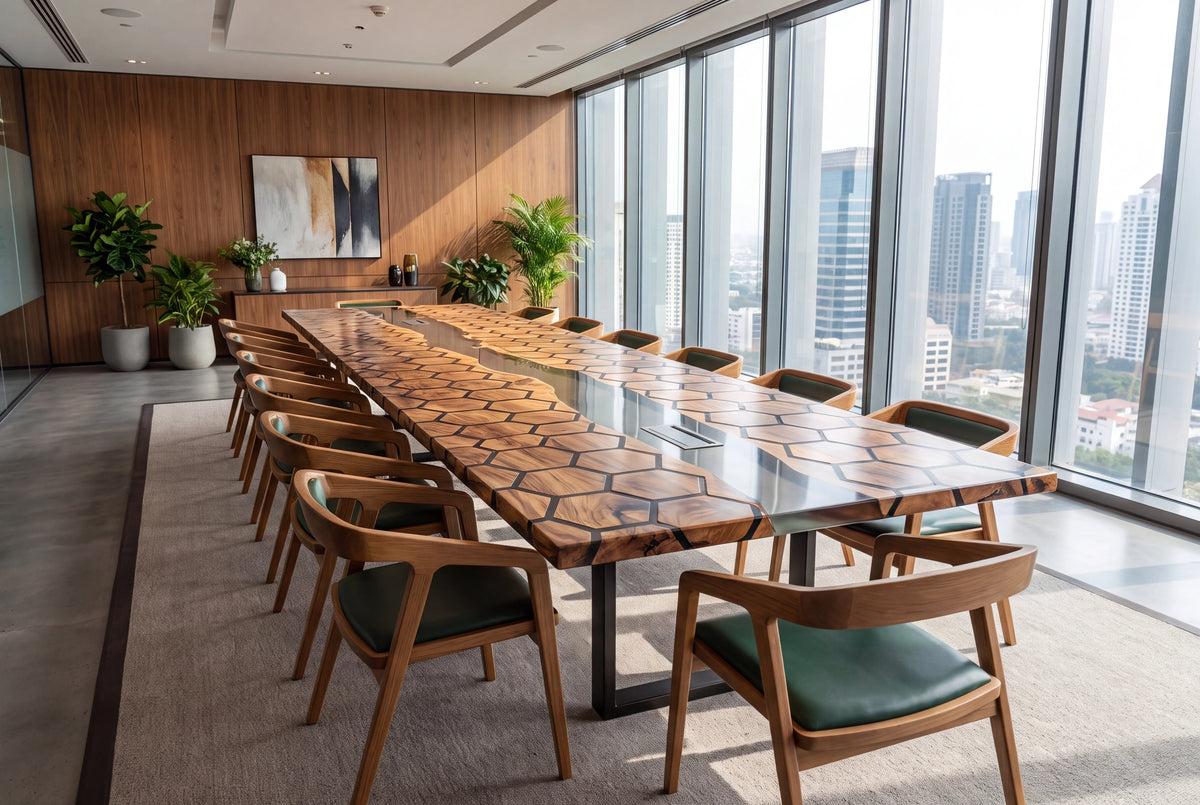
Yes, a custom conference table can have power and data built in: outlets in the top, grommets for cables, and a cable route down through the base to a floor box or wall. The key is to plan it before production, because the openings and the cable path are part of the table's design, not an add-on.
This guide covers what a powered table includes, how many outlet positions a room needs, where to put them, and how the cables reach a table that stands in the middle of the floor. Every design in our conference table collection can be made with power, data and cable management fitted to the way your team meets.
What does a conference table with power and data include?
A powered conference table is a set of small decisions, not a single feature. Most rooms need some mix of these five parts:
| Part | What it does | What you decide |
|---|---|---|
| Power outlets in the top | Let people charge laptops and phones without crawling under the table | How many positions, and where |
| Data (network) ports | Give a wired connection to a conference phone, a room controller or laptops | How many ports, and at which seats |
| Grommets | Openings that let cables pass through the top, for example a screen cable your AV installer provides | Size and position, usually near the head of the table |
| Cable management under the top | Keeps cords off the floor and away from knees | The route from each opening to the base |
| Building connection | Brings power and network to the table from a floor box or wall | Where the building supply is, agreed with your electrician |
At Onyx Resin, power and data outlets, grommets and cable management are integrated into the table and fitted to your needs. Everything is priced per project through a quote.
How many outlets does a conference table need?
There is no single rule, so start by counting devices, not seats. Ask how many people plug in a laptop at the same time during a normal meeting, and whether the room has a conference phone, camera or touch panel that also needs power or a network port.
Universities publish useful reference points because they fit out many meeting rooms. The University of South Dakota's construction standards for audiovisual spaces call for at least one duplex outlet in each media well on a conference table, a floor box with duplex power, network and space for AV cabling, and two network connections for a conference phone and a touch panel controller.
From there, the outlet count depends on how your team works. This table shows two common ways to plan positions on the top:
| Seats | One power position per seat | One shared position per two seats |
|---|---|---|
| 6 | 6 | 3 |
| 8 | 8 | 4 |
| 10 | 10 | 5 |
| 12 | 12 | 6 |
| 16 | 16 | 8 |
| 20 | 20 | 10 |
A position per seat suits rooms used for long working sessions where everyone has a laptop open. A shared position suits boardrooms used mainly for short meetings and presentations. Whichever you choose, give the head of the table its own power and a grommet, since that is where the presenter usually connects to the screen.
Where should outlets and grommets go on the table?
Placement decides whether the power is used or ignored. Three questions settle most layouts:
- Center line or near each seat? A row of positions along the center of the top serves both sides of the table with fewer openings. Positions closer to the edge are easier to reach but add more openings.
- Where is the screen or camera? Put the grommet for video and network cables at the end nearest the screen, so cables do not cross the table.
- Where does the base stand? Cables need a clear path from each opening down to the base and the floor. The layout and the base are planned together.
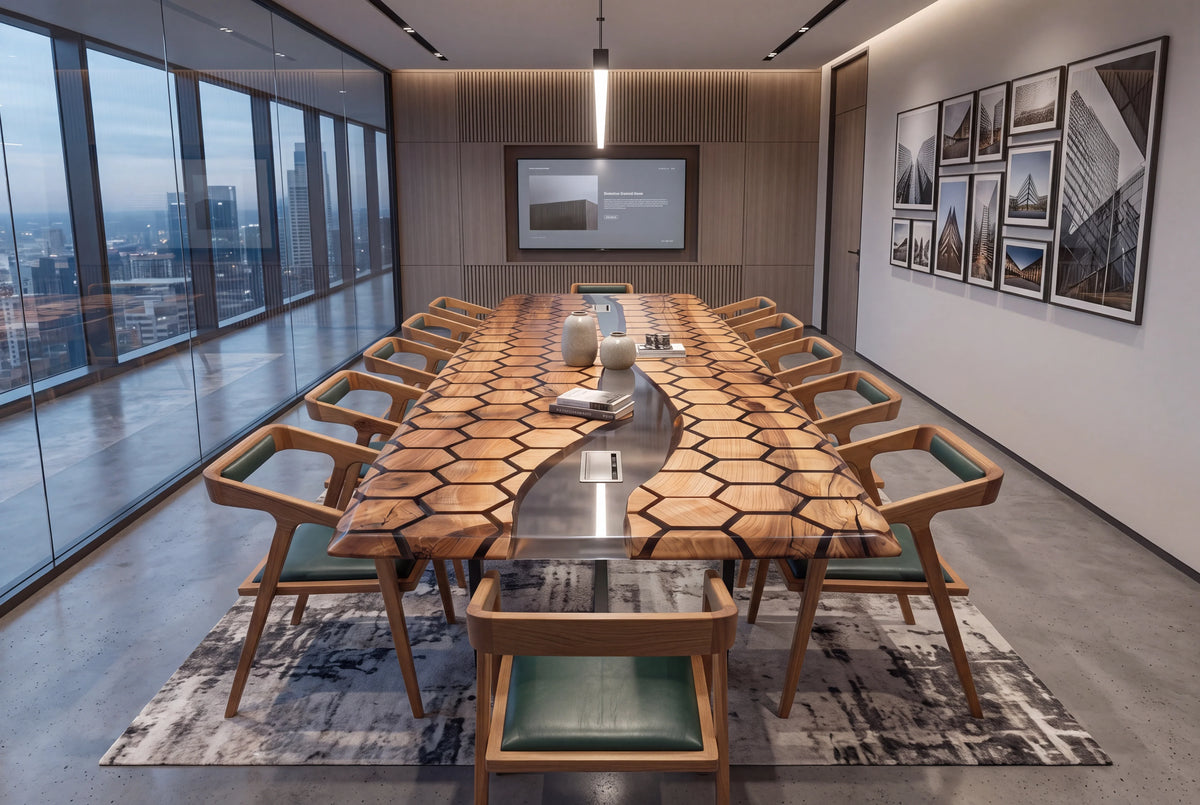
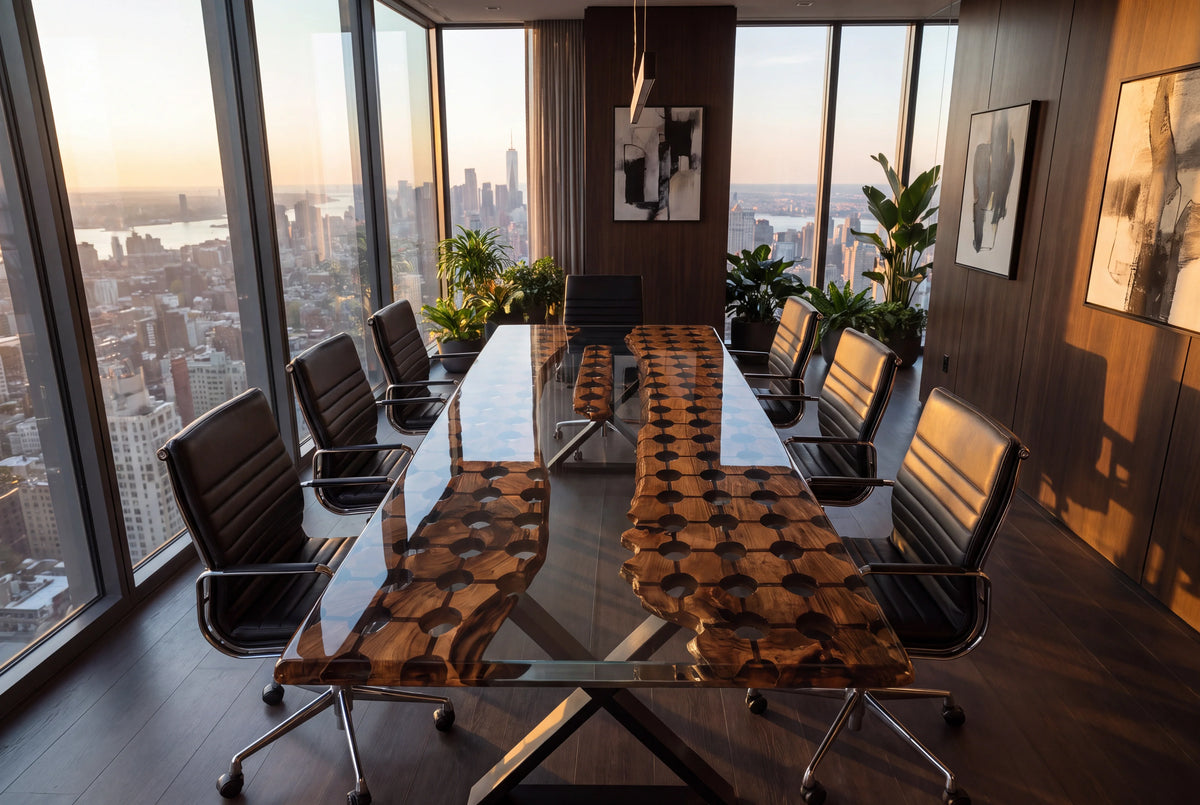
On a resin table, the pattern matters too. On a design like the Tessellate walnut conference table, with its clear resin honeycomb, or the Lens walnut conference table, with its circular cutouts, the positions are planned with you before production so they sit well with the pattern instead of cutting through it at random.

If you also want a company logo on the table, mention it at the same time. The logo detail is worked out in the preview before production, and planning both together keeps outlets and logo from competing for the same spot.
How do cables reach a conference table in the middle of the room?
This is the question most buyers forget until the table arrives. A table in the middle of a room is far from the wall outlets, so the power has to come from somewhere. There are two usual routes.
From a floor box under the table
A floor box set into the floor below the table is the tidiest option. The table's cable route runs down through the base and connects to the box, so nothing crosses the floor. The South Dakota standard describes exactly this setup: a floor box with power, network and AV space under the table, a 1.25-inch AV conduit from the floor box to the equipment rack, and an installer or contractor who connects the table's power to the floor box. If your office is being fitted out or renovated, this is the moment to ask for a floor box where the table will stand.
From a wall outlet
Without a floor box, power has to travel from the wall. Workplace safety rules matter here. In the United States, OSHA's electrical standard says flexible cords may not be used as a substitute for the fixed wiring of a structure, or run through holes in walls, ceilings or floors, in permanent installations. The Office of Congressional Workplace Rights adds that chaining power strips and extension cords together violates OSHA rules and the National Electrical Code, that cords across walkways are a tripping hazard, and that extra floor or wall outlets, or furniture with built-in power, are the better fix.
The practical answer: bring in a licensed electrician early, tell them where the table will stand, and agree on where the building supply will be. In Europe, local wiring rules apply, so the same conversation with a local electrician covers it. Then send us the position of that floor box or wall outlet, and the cable route through the table and base is planned to meet it.
How is cable management planned on a custom epoxy table?
On a made-to-order table, power is part of the design from the first conversation. Here is how it fits into an order:
- Quote request. You send the room size, seat count, the style you like, and your power and data needs. Within 48 hours you receive an AI-rendered preview and a full quote, or real photos of similar past work.
- Layout before production. Outlet, data and grommet positions and the cable route are agreed with you, and any logo is worked out in the preview.
- Slab approval and production. After a one-third deposit, we send a photo of the actual wood slab for approval. Production takes 3 to 8 weeks after design approval, with photo updates at every stage.
- Delivery. Shipping takes 1 to 3 weeks, so plan for 4 to 11 weeks in total. The table arrives in a custom wooden crate with the top and base packed separately, and assembly is required on site. Plan for your electrician to connect the table to the building supply once it is assembled.
You can choose one of our steel leg designs or a fully custom base. Mention your cable needs when you pick the base, so the route down to the floor is planned with it. Our How It Works page covers the full ordering process.

Which designs can be made with power and data?
All of them. The Yin Yang walnut conference table, with black and white resin, suits a high-contrast boardroom, while Tessellate and Lens suit modern offices that want pattern without strong color.

Our conference collection shows four designs, but it is not the full range. Every design in our dining table collection can also be made at conference table size, with the same wood, resin color and base options, and with power and data built in. A design like the Atlantic walnut table, with its blue resin river, works just as well as a boardroom table for 10 or 12 people.
What should you send with your quote request?
A complete brief gets the power layout right on the first preview. Include:
- Room length and width, and the position of doors, windows and the screen
- Number of seats, including how many at each end
- How many people need power at once, and whether you want a position per seat or shared positions
- How many network ports you need, and for which devices
- Where the floor box or nearest wall outlet is, or will be
- Wood (walnut, olive or poplar), resin color and base preference
- Logo file and placement, if you want one
- Delivery city and the date the room needs to be ready
For an overview of what drives the price of a custom piece, see our custom epoxy resin table cost guide.
Frequently asked questions
Can you add outlets to a conference table after it is made?
It is far better to plan them before production. The openings and the cable route are designed into the top and base, so send your power and data needs with your quote request and the layout is agreed with you before production.
Do I need an electrician for a conference table with power?
Plan for one. The table brings power and data to the top, but the connection to the building supply, whether a floor box or a wall outlet, is work for a licensed electrician who knows your local rules.
Can a conference table have data ports as well as power?
Yes. Power and data outlets, grommets and cable management are fitted to your needs. Tell us how many network ports you need and which devices they serve.
Can the same table have power outlets and a company logo?
Yes. Both are planned together before production, so the outlets and the logo each get their own place on the top.
How long does a conference table with power and data take?
The preview and quote arrive within 48 hours. Production takes 3 to 8 weeks after design approval and shipping 1 to 3 weeks, so plan for 4 to 11 weeks in total.
Do you deliver conference tables to offices in the US and Europe?
Yes. Worldwide delivery is included and insured, in a custom wooden crate. Customs duties are not included and are paid by the recipient.
Plan your powered conference table with a free quote
Send us your room size, seat count and power and data needs. You will get a free quote and an AI preview of your table within 48 hours. Request your free conference table quote, or browse the epoxy conference table collection for ideas first.

Leave a comment
All comments are moderated before being published.
This site is protected by hCaptcha and the hCaptcha Privacy Policy and Terms of Service apply.